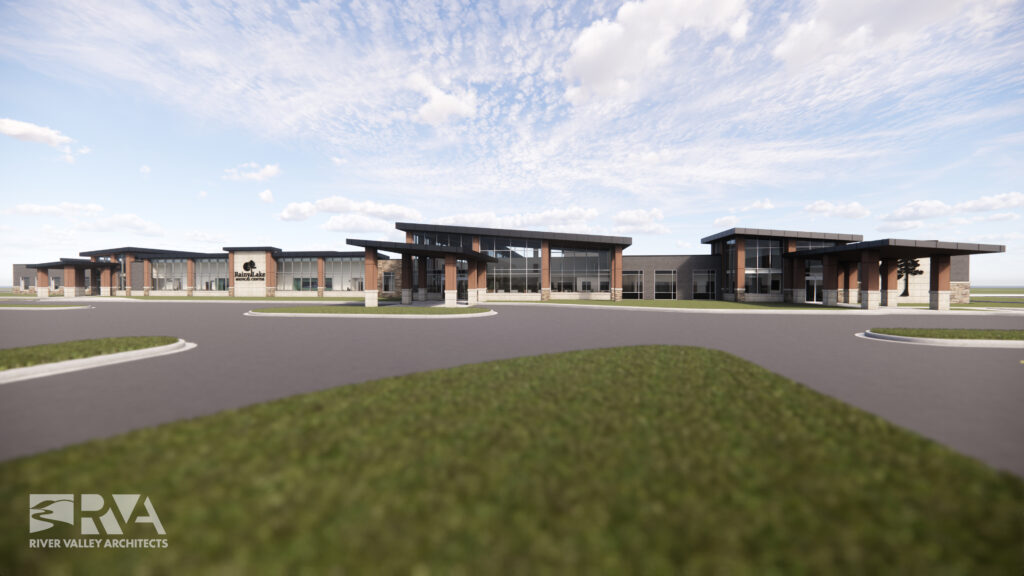
Rainy Lake Medical Center (RLMC) this week provided an update on the status of its H.O.M.E. Project-new hospital build, reaffirming its long-term commitment to advancing the project while navigating a challenging and increasingly uncertain federal funding environment.
Like many rural healthcare organizations across the country, RLMC is experiencing delays driven in large part by federal-level decisions and economic conditions outside of its control. Interest rates remain elevated, significantly increasing the cost of borrowing for large-scale infrastructure projects and limiting the feasibility of traditional financing models.
At the same time, ongoing changes and proposed reductions to federal programs have created additional barriers. Uncertainty surrounding the future of U.S. Department of Agriculture (USDA) Rural Development funding, including potential cuts and shifting program requirements, has directly impacted projects like the H.O.M.E. Project that rely on stable, long-term federal partnership.
For decades, USDA Rural Development programs have been a cornerstone for rural hospitals seeking to modernize facilities and maintain access to care. Today, that foundation is less predictable, forcing organizations like RLMC to reassess timelines, financing strategies, and overall project structure.
“Our commitment to this project has not changed,” said Robb Pastor, CEO of Rainy Lake Medical Center. “What has changed is the environment around us. Federal policy uncertainty and rising interest rates have made it more difficult to move forward under the original plan.”
Pastor emphasized that RLMC is taking a deliberate and disciplined approach in response.
“We will not move forward in a way that puts the long-term stability of this organization at risk,” he said. “Maintaining our independence is critical. Given the level of uncertainty at the federal level, it would be irresponsible to proceed without fully understanding the long-term financial impact.”
Behind the scenes, RLMC continues to actively explore alternative funding pathways, including new financing structures, partnerships, and phased approaches that reduce reliance on any single federal program.
The need for the project remains clear.
RLMC continues to experience strong growth and has expanded access to care across the region. That growth has placed increasing strain on the hospital’s current facility, which is now
more than 50 years old and no longer supports modern healthcare delivery in an efficient or sustainable way.
“Our current building is outdated and increasingly difficult to operate efficiently,” Pastor said. “We have outgrown the space, and the need for a modern facility has only increased.”
The H.O.M.E. Project is designed to address these challenges by creating a modern, efficient, and patient-centered healthcare environment that will support the community for generations.
RLMC leadership will continue to keep the community informed as progress continues.
“There is a significant amount of work happening behind the scenes,” Pastor said. “We are committed to moving this project forward, but we are also committed to doing it the right way. That means adapting to the realities in front of us while protecting the future of this organization.”
Rainy Lake Medical Center remains committed to its mission of providing high-quality, accessible healthcare and to ensuring that any path forward strengthens its ability to serve the community as an independent organization.